Publishing My First Springer Research Paper: The Story Behind WorkExperio
Every meaningful project begins with a simple question. For us, that question was: "Can Artificial Intelligence make student collaboration more effective?" What started as a classroom discussion eventually grew into our final-year project, evolved into research, and finally became a Springer publication.
📖 Research Milestone
Our research paper, WorkExperio: An AI-Enabled System for Automated Team Formation and Performance Analytics, was accepted at the 10th International Conference on Smart Trends in Computing and Communications (SmartCom 2026) and published by Springer Nature in the Lecture Notes in Networks and Systems (LNNS), Volume 1990.
The Story Didn't Start with Research
When people hear about a Springer publication, they usually see only the final outcome—a published paper. What often goes unnoticed is the journey behind it. Long before we wrote the first paragraph of our manuscript, we were simply a group of engineering students trying to solve a problem we had personally experienced.
Every semester, project teams were formed with enthusiasm. However, after a few weeks, familiar challenges started appearing. Some students carried most of the workload, while others struggled to find responsibilities that matched their strengths. Communication gaps, unclear role distribution, and inconsistent collaboration often affected both the learning experience and project outcomes.
Rather than accepting these challenges as normal, we asked ourselves whether technology—and more specifically Artificial Intelligence—could assist educators and students in creating more balanced and productive teams.
From an Idea to WorkExperio
That simple question became the foundation of WorkExperio. Instead of viewing AI as a replacement for human decision-making, we envisioned it as an intelligent assistant capable of supporting project-based learning. The objective was never to automate education; rather, it was to provide meaningful insights that help students collaborate more effectively.
The platform was designed around a straightforward philosophy: understand students' skills at a high level, encourage balanced team formation, support structured project workflows, and provide meaningful performance insights throughout the collaboration process.
💡 Key Idea
WorkExperio is not about replacing teamwork with AI. It is about helping students build stronger teams by making informed decisions and encouraging structured collaboration.
My Contribution
Like every collaborative research project, WorkExperio was built through the combined efforts of an incredible team. My primary responsibility focused on the Artificial Intelligence and Machine Learning aspects of the project.
I explored approaches for analysing technical skills, supporting intelligent team formation, and contributing to performance-oriented insights. One of the most rewarding parts of this experience was applying AI concepts to a practical educational problem rather than treating them as isolated academic exercises.
More importantly, this project changed the way I think about AI. It reminded me that successful AI systems are not measured only by algorithms—they are measured by the value they create for people.
What Made This Project Special?
- Applying AI concepts to a real educational challenge.
- Building an industry-inspired collaborative learning platform.
- Working as part of a multidisciplinary research team.
- Transforming an academic project into a Springer publication.
- Learning the complete research lifecycle—from ideation to publication.
The Research Journey
Turning a software project into a research publication was an entirely different experience. Developing a working solution was only one part of the journey. Every design decision needed justification, every observation required evidence, and every statement had to be presented clearly and responsibly.
This process taught me patience, attention to detail, and the importance of continuous improvement. Revising drafts, discussing ideas with co-authors, refining our explanations, and ensuring clarity became just as important as writing code.
🗺️ Research Journey
Problem Identification → Idea Validation → Project Development → Research Writing → Paper Review → SmartCom 2026 → Springer Publication
A Moment I'll Always Remember
Receiving confirmation that our paper had been accepted was one of the most memorable moments of my undergraduate journey. It represented months of learning, collaboration, experimentation, and perseverance.
For me, this publication is more than a research paper. It is a reminder that meaningful ideas can grow into impactful work when curiosity, teamwork, and persistence come together.
Conference Recognition
As part of this journey, our work was presented through SmartCom 2026 and officially selected for Springer publication. The conference certificate represents an important milestone and serves as a reminder of the dedication invested throughout the research process.
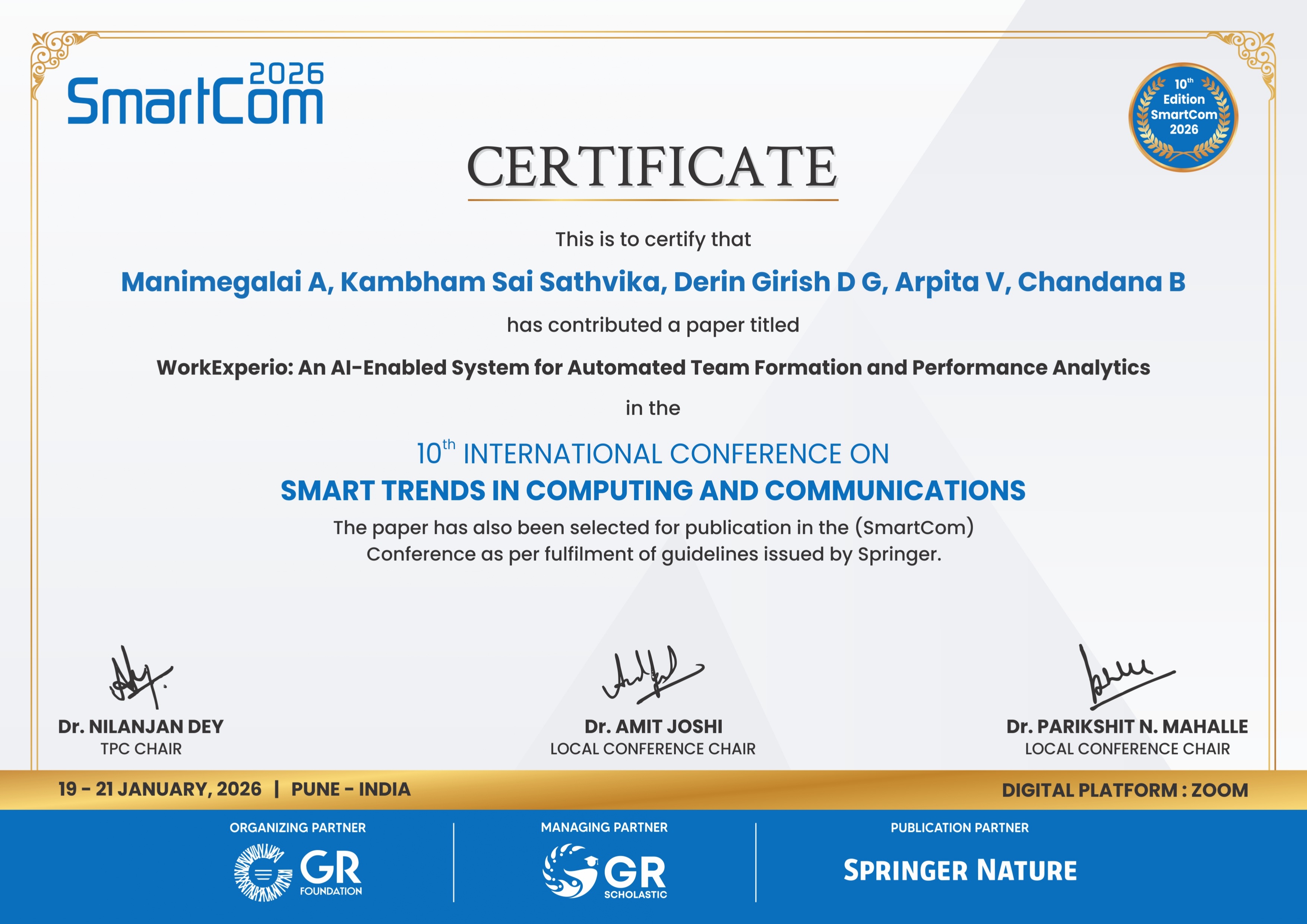
Click the certificate to view the full-size image.
Publication Details
- Paper: WorkExperio: An AI-Enabled System for Automated Team Formation and Performance Analytics
- Conference: SmartCom 2026
- Publisher: Springer Nature
- Series: Lecture Notes in Networks and Systems (LNNS)
- Volume: 1990
- DOI: https://doi.org/10.1007/978-3-032-26908-9_38
What I Learned
Looking back, this journey taught me lessons that extend well beyond technology. I learned how research demands critical thinking, disciplined experimentation, effective communication, and collaborative problem-solving. I also discovered that impactful engineering begins with understanding real problems before attempting to build solutions.
Perhaps the most valuable lesson was realizing that every successful publication is the outcome of countless small improvements made consistently over time.
🌱 Looking Ahead
This Springer publication marks the beginning—not the destination—of my research journey. I hope to continue exploring Artificial Intelligence, Machine Learning, Software Engineering, and intelligent systems while building solutions that create meaningful impact.
Acknowledgements
This achievement would not have been possible without the guidance of our mentor and the collaboration of my co-authors. I sincerely thank A. Manimegalai, Kambham Sai Sathvika, V. Arpita, and B. Chandana for their support, knowledge sharing, and teamwork throughout this journey.
Finally, thank you to every teacher, friend, and peer who encouraged us throughout this experience. Research is rarely an individual effort—it grows through collaboration, curiosity, and a shared commitment to learning.